Knee Replacement
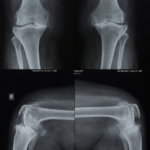
Millions of people suffer from knee pain and stiffness – often due to degenerative joint disease like osteoarthritis. Physical trauma and joint diseases can significantly impair mobility and quality of life during even the simplest of activities. Although conservative measures are the first line of defense, many patients require total knee replacement surgery to relieve their knee pain and restore their function.
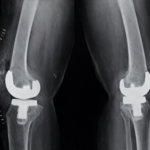
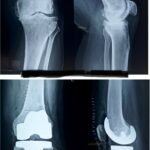
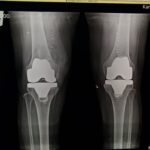
Knee replacement surgery involves removing the arthritic bone from the thigh bone (femur) and shin bone (tibia). The removed bone is replaced with metal and special plastic. During the surgery, the arthritic bone underneath the knee cap is also removed and replaced with a plastic button. The prosthesis utilizes the patient’s native ligaments and muscles for movement and stability.
The use of robotics and computer navigation has revolutionized the way that knee replacement surgery is performed. The procedures can be performed with greater accuracy and allow more rapid recovery. Additionally, patients with previous injury or deformity of their knee who may have been once told surgery is not an option for them may be candidates for robotic-assisted procedures.
Frequently Asked Questions
You may be a candidate for total knee replacement surgery if you have osteoarthritis or joint damage that has not adequately responded to more conservative methods of treatment, such as physical therapy. Although knee replacements are considered safe and highly effective, results still vary from patient to patient. It is important to discuss your options with your orthopedist to determine if total knee replacement is right for you.
Total knee replacement surgery is an inpatient procedure that is performed using general/Spinal anesthesia. Your doctor will make an incision, exposing the bone beneath. Damaged cartilage and a small amount of the bone will be removed and replaced by metal implants that are either cemented or pressed into the bone. Finally, your doctor may resurface your patella and insert a smooth spacer into your joint to facilitate fluid movement. The entire procedure usually takes no more than 1 or 2 hours.
You will probably spend several days in the hospital after your surgery. During this time, the medical staff and your orthopedist will monitor your condition to ensure you are comfortable and that you are not developing unwanted blood clots after surgery. Your doctors and nurses will also work to prevent complications of surgery, such as pneumonia. Expect to begin a physical therapy regimen within 24 hours of your knee replacement. It will be important to continue these exercises for many weeks to facilitate a strong recovery.
The operation is approximately 2 hours.
Yes, it can. The use of robotic or computer assistance adds an additional level of accuracy and precision to the procedure to ensure appropriate positioning of components and minimize soft tissue injury.
Knee replacements consist of a few different parts. The femoral component is made of cobalt chrome, the tibial component is made of titanium and the insert is composed of highly cross-linked polyethylene. The patellar is resurfaced with a button made of highly cross-linked polyethylene also.
We have been able to make significant improvements in the components that we use during knee replacement surgery. Combining the newer materials with robotic assistance translates into better outcomes and increased longevity of implants.
This is different for each patient; some are able to use Tylenol or Advil after you leave the hospital, and others require pain medication as needed for 2-3 weeks. A general rule is that you should try to decrease your use of these medications as time passes.
Most patients stay in the hospital one night and are discharged the day after their operation. Each patient must meet medical criteria for discharge as well as clear physical therapy. If you require more therapy or medical management we will delay discharge until those needs are addressed.
I like to see you in follow up before you go as an outpatient; that way I can tailor your PT to what you need. However, if you feel that it is essential that you begin outpatient PT right away, you can call my office and we will provide a prescription and a list of places.
You should not drive as long as you are taking narcotic pain medication. Since you are able to sit in regular chairs when you are comfortable, you will be able to drive when you are comfortable sitting and able to lift your leg from side to side. If it is your left knee, you can resume driving when you feel your reaction times are back to normal (about 2-3 weeks). If it is your right knee, you may need to wait another 2 weeks.
The clicking is a result of the soft tissues moving across around the knee, or the artificial parts coming into contact with one another. This sensation usually diminishes as your muscles get stronger.
Fluid can accumulate in the legs due to the effect of gravity. It is not unusual that you didn’t have it in the hospital, but it got worse when you went home (because you are doing more!) To combat this, you should elevate your legs at night by lying on your back and placing pillows under the legs so that they are above your heart. There are also TEDS stocking (the white stockings from the hospital) that you can put on during the day – have someone help you on with them in the morning, use them during the day, and then take them off at night. If you did not get the TEDS from the hospital, you can purchase knee high, medium (15-20 mm Hg) compression surgical stockings at most drug stores.
You can go to the gym and resume upper body workouts (you should be sitting, not standing, when using weights). Do not swim or do any activities involving submerging the incision in water.
It depends on your occupation. It is never a mistake to take more time off in the beginning of your recovery, as it will give you time to focus on your knee. I recommend taking at least 4 weeks off after a TKR. Keep in mind that you will still need to use a chair cushion and a high toilet seat for 6 weeks after surgery.
In general, I like to see you before you fly within 6 weeks of surgery. If you are traveling by car, you should be sure to take frequent breaks so that you don’t feel too stiff when getting up. On an airplane, I like you to wear compression stockings (if within 1-month postop), and take a couple of walks during the flight. Having an aisle and bulkhead seat will help you get more space.
Explore Our Journey